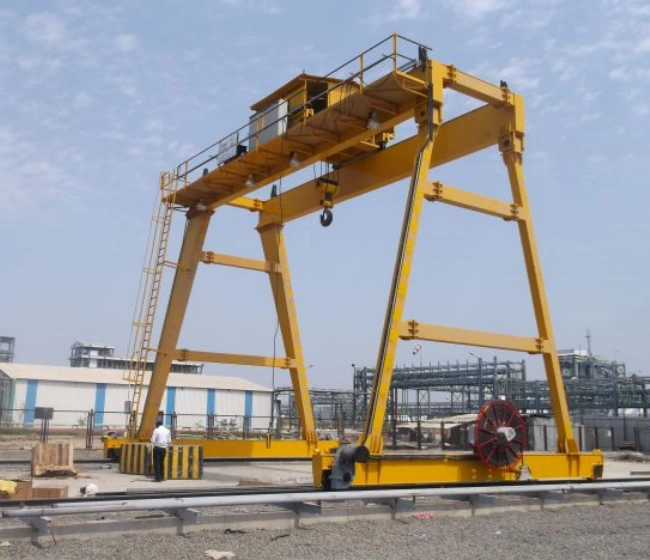
How to Accurately Calculate Overhead Crane Span?
The span of an overhead crane is the horizontal distance between the centerlines of the two runway rails. It is a critical parameter that determines working coverage, prevents rail gnawing, and avoids structural interference.

1. Definition
Span S (meters) = perpendicular distance between the left rail centerline and the right rail centerline.
2. Standard Formula
S = L - 2a
L = Clear inside width of the building (between inner edges of columns), in meters
a = Safety margin from rail centerline to column inner edge (includes rail clamp, bumper, and clearance), typically 0.2 m – 0.5 m
Example:
3. Practical Adjustments
| Condition | Recommended Action |
|---|---|
| Loads must reach near walls | Use a=0.2 m (minimum) |
| Heavy rails or large clamps | Increase a by 0.1–0.2 m |
| Standard crane (double/single girder) | Use manufacturer’s end truck matched to S |
| Custom design | Verify trolley extreme clearance to column |
4. Step-by-Step Engineering Calculation
Measure accurately: Clear width L between inner column edges (±10 mm). Do not use building axis distance.
Determine safety margin: Per GB/T 14405, a≥200 mm.
Calculate preliminary span: S=L−2a.
Round to standard span: Refer to standard series (10.5, 13.5, 16.5, 19.5, 22.5, 25.5, 28.5 m, etc.). Select the nearest value not less than calculated S (tolerance ±10 mm).
Final check: Minimum clearance from hook to column inner edge ≥ 100 mm.
5. Key Warnings
❌ Never use building axis distance instead of clear width L (axis passes through column center).
❌ For outdoor cranes, ignore building dimensions – measure actual rail centerlines on site.
✅ For retrofits, directly use existing rail centerline distance as span.
Accurate span calculation eliminates rail gnawing, dead zones, and girder-column interference. Always have the crane manufacturer validate dimensions on site before final fabrication.
What is an EOT Crane? Complete Guide
What Size Overhead Crane Do I Need for a 10 Ton Load?