


OVERHEAD CRANE
-
Single Girder Overhead Crane
- LXB Type Explosion-proof Electric Single Girder Suspension Crane
- LX Electric Single-girder Suspension Crane
- LDZ Electric Single Girder Crane
- LDY Metallurgical Single Girder Crane
- LDP Type Electric Single Girder Overhead Crane
- LD Electric Single-girder Crane
- LB Type Explosion-proof Electric Single Girder Crane
- Flexible Suspension Single-girder Bridge Crane
- Single-Girder Bridge Grab Crane
- Single Girder Hoist Overhead Crane
- SL Manual Single-girder Bridge Crane
-
Double Girder Overhead Crane
- QZ Grab Crane
- QD Double Girder Overhead Crane
- QC Electromagnetic Crane
- QB Type Explosion-proof Hook Bridge Crane
- LHB Type Explosion-proof Hoist Double Girder Crane
- Double-girder Bridge Casting Crane
- Four Girder Casting Crane
- Magnet Double Girder Overehad Crane
- Explosion-proof Double-girder Bridge Crane
- Double Girder Overhead Crane
- European Standard Crane
HOT PRODUCTS
Four Girder Casting Crane
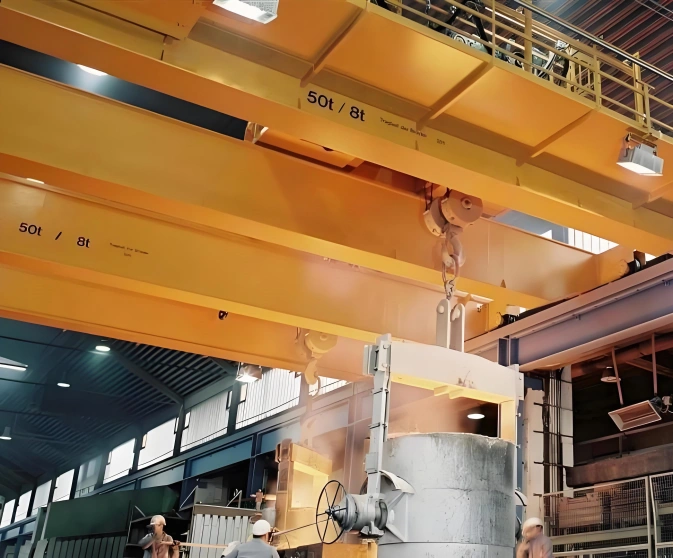
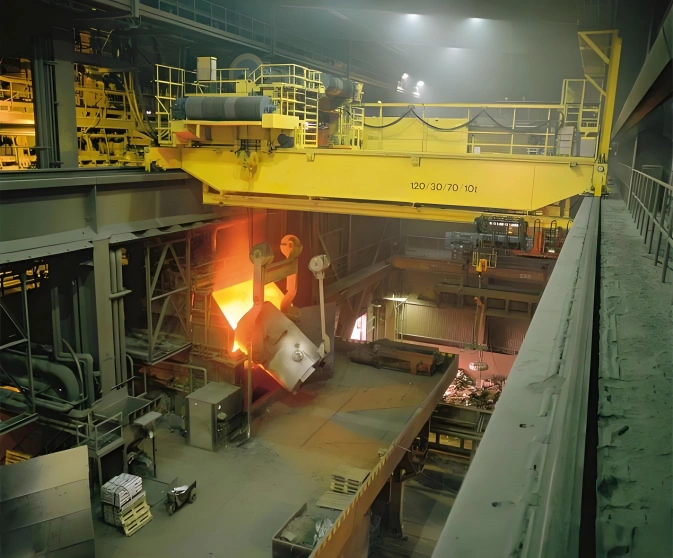
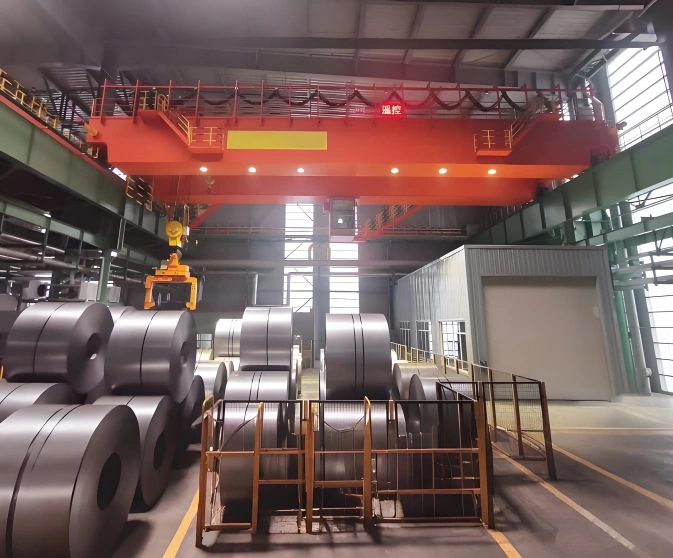
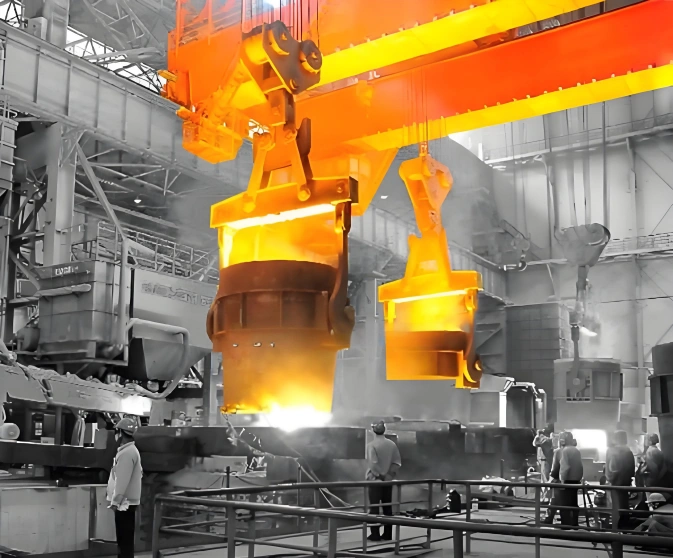
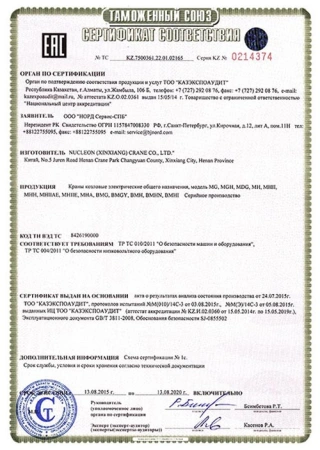
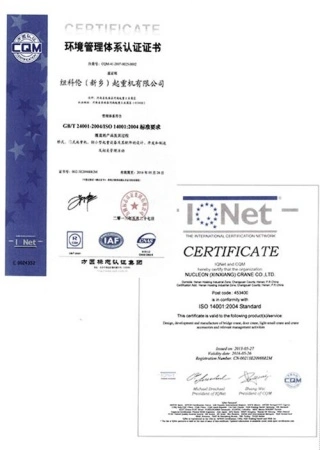
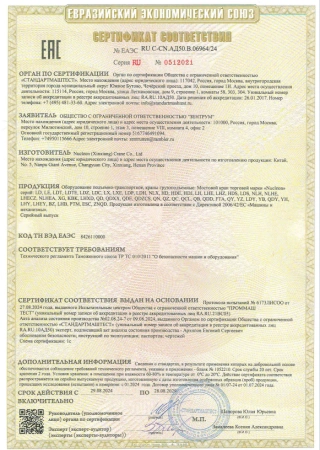
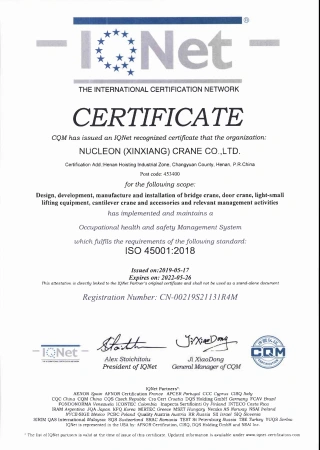
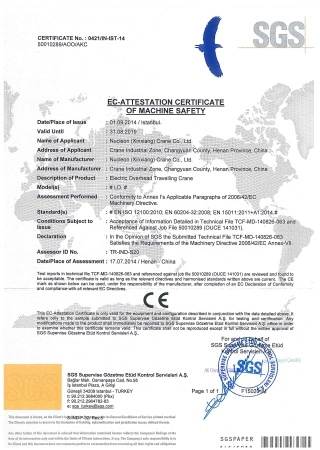
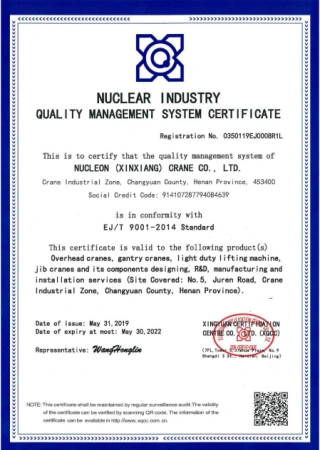
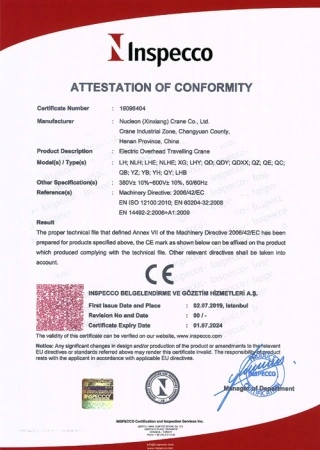
Authentication mark:


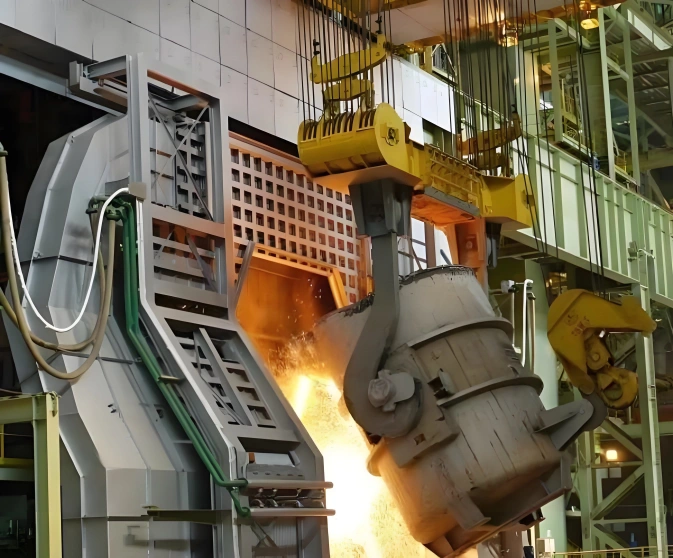
This crane is mainly used in steelmaking plants, heavy foundries, and non‑ferrous metal smelters.
Capacity:
125 t – 650 t+ customizable
Lifting Height:
8 m – 35 m+ (customizable based on workshop height & ladle clearance)
Span:
13 m – 35 m+ (customizable for extra-wide workshops)
Voltage/Hertz:
380V/50HZ, three-phase (As you local condition)
Working Class:
A7, A8 (Heavy-duty / Very heavy-duty for molten metal)
Get A Free Quote

WhatsApp
Introduction
Application Scenario
Advantages
Structural Diagram And Parameter Table
INTRODUCTION
What is this?
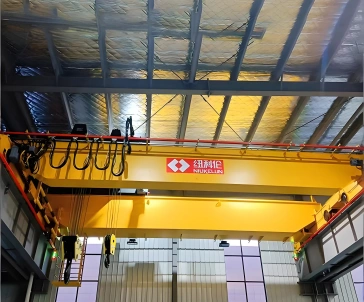
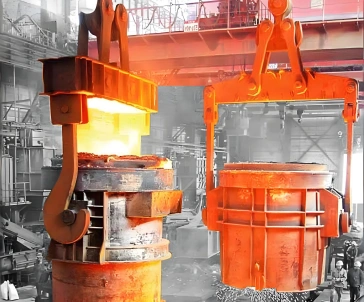
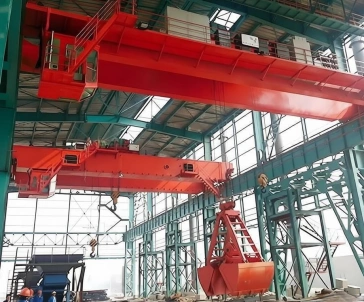
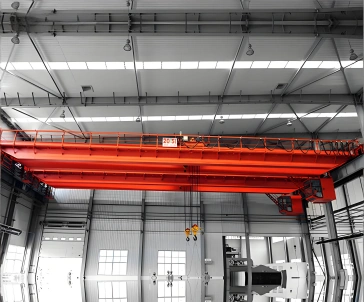
The four girder casting crane is a heavy-duty, high-temperature molten metal handling device designed for extra-large steelmaking workshops. It features a four-girder, six-rail structure, with main and auxiliary trolleys driving the main and auxiliary hooks independently, achieving safe, stable, and precise lifting and pouring of extra-large capacity molten steel and iron ladles. If you are managing a large steel plant or foundry requiring lifting of ladles over 125 tons, with extremely high demands for safety, stability, and operational efficiency, this product is designed for you.
Why choose a four girder casting crane over a standard double girder casting crane?
Compared to standard double girder casting cranes, the four girder casting crane offers four core advantages:
First, stronger load capacity – the four-girder, six-rail structure distributes loads more evenly, with lifting capacity from 125 tons to over 650 tons, meeting extra-large ladle handling requirements.
Second, higher structural rigidity – four main girders share the load, resulting in smaller beam deflection, smoother operation over long spans, and more precise ladle positioning.
Third, better trolley layout – main and auxiliary trolleys are separated; the main hook handles ladle lifting while the auxiliary hook operates independently for slag handling and auxiliary tasks, avoiding interference and improving efficiency.
Fourth, higher safety redundancy – dual-brake hoisting mechanism, overspeed switch, and load cell provide multiple protection layers, with high-temperature resistant design on key components to withstand extreme heat radiation.
Tackle the most demanding smelting tasks with a stronger structure.
What can we do for you?
We understand that every customer has different ladle capacities, different workshop spans, and different process requirements. Therefore, we offer flexible customization options: lifting capacity from 125 tons to over 650 tons; span from 13 meters to over 35 meters; main/auxiliary hook ratios such as 260/80t, 350/100t, etc.; control options of cabin or remote radio; standard VVVF speed control. Whether your workshop is new construction or a renovation, we can match the most suitable span and lifting height.
Unsure? Don't know?
Not sure whether to choose a four girder or double girder structure? Not sure what main/auxiliary hook capacity ratio suits your ladle? No problem. Just tell us: your ladle capacity or molten steel weight, your workshop span, and your handling frequency (how many heats per day). Our engineers will provide you with an accurate quote and CAD drawings within 24 hours. Click the button below or contact us via WhatsApp/email to get your customized solution.
Tip: We offer free selection consulting. Even if you are unsure about specific parameters, feel free to describe your melting process and workshop dimensions, and we will calculate for you.
The four girder casting crane is a heavy-duty, high-temperature molten metal handling device designed for extra-large steelmaking workshops. It features a four-girder, six-rail structure, with main and auxiliary trolleys driving the main and auxiliary hooks independently, achieving safe, stable, and precise lifting and pouring of extra-large capacity molten steel and iron ladles. If you are managing a large steel plant or foundry requiring lifting of ladles over 125 tons, with extremely high demands for safety, stability, and operational efficiency, this product is designed for you.
Why choose a four girder casting crane over a standard double girder casting crane?
Compared to standard double girder casting cranes, the four girder casting crane offers four core advantages:
First, stronger load capacity – the four-girder, six-rail structure distributes loads more evenly, with lifting capacity from 125 tons to over 650 tons, meeting extra-large ladle handling requirements.
Second, higher structural rigidity – four main girders share the load, resulting in smaller beam deflection, smoother operation over long spans, and more precise ladle positioning.
Third, better trolley layout – main and auxiliary trolleys are separated; the main hook handles ladle lifting while the auxiliary hook operates independently for slag handling and auxiliary tasks, avoiding interference and improving efficiency.
Fourth, higher safety redundancy – dual-brake hoisting mechanism, overspeed switch, and load cell provide multiple protection layers, with high-temperature resistant design on key components to withstand extreme heat radiation.
Tackle the most demanding smelting tasks with a stronger structure.
What can we do for you?
We understand that every customer has different ladle capacities, different workshop spans, and different process requirements. Therefore, we offer flexible customization options: lifting capacity from 125 tons to over 650 tons; span from 13 meters to over 35 meters; main/auxiliary hook ratios such as 260/80t, 350/100t, etc.; control options of cabin or remote radio; standard VVVF speed control. Whether your workshop is new construction or a renovation, we can match the most suitable span and lifting height.
Unsure? Don't know?
Not sure whether to choose a four girder or double girder structure? Not sure what main/auxiliary hook capacity ratio suits your ladle? No problem. Just tell us: your ladle capacity or molten steel weight, your workshop span, and your handling frequency (how many heats per day). Our engineers will provide you with an accurate quote and CAD drawings within 24 hours. Click the button below or contact us via WhatsApp/email to get your customized solution.
Tip: We offer free selection consulting. Even if you are unsure about specific parameters, feel free to describe your melting process and workshop dimensions, and we will calculate for you.
APPLICATION SCENARIO
[1] Steelmaking Plants – Transporting and tilting molten steel ladles from converters to continuous casting machines.
[2] Foundries – Pouring molten iron into molds for casting large components such as engine blocks, turbine housings, and heavy machinery parts.
[3] Non‑Ferrous Metal Smelters – Handling ladles of molten aluminum, copper, or zinc under high‑temperature conditions.
[4] Integrated Steel Mills – Serving the BOF (Basic Oxygen Furnace) or EAF (Electric Arc Furnace) shops for hot metal transfer.
[5] Ladle Repair and Pretreatment Stations – Hoisting ladles for cleaning, lining repair, and preheating before filling.
[2] Foundries – Pouring molten iron into molds for casting large components such as engine blocks, turbine housings, and heavy machinery parts.
[3] Non‑Ferrous Metal Smelters – Handling ladles of molten aluminum, copper, or zinc under high‑temperature conditions.
[4] Integrated Steel Mills – Serving the BOF (Basic Oxygen Furnace) or EAF (Electric Arc Furnace) shops for hot metal transfer.
[5] Ladle Repair and Pretreatment Stations – Hoisting ladles for cleaning, lining repair, and preheating before filling.
ADVANTAGES
[1] High Thermal Protection – Heat shields, insulated platforms, and special heat‑resistant coatings protect all critical components.
[2] Ultra‑High Load Capacity – Four‑girder design provides superior strength, capable of lifting over 500 tons.
[3] Fail‑Safe Braking and Redundancy – Dual braking systems and independent mechanical backups ensure safety when handling molten metal.
[4] Smooth and Precise Tilting – Specially designed ladle tilting mechanism allows controlled pouring with minimal splash.
[5] High Duty Cycle – Designed for A8 duty class, operating 24/7 in harsh environments with minimal maintenance.
[2] Ultra‑High Load Capacity – Four‑girder design provides superior strength, capable of lifting over 500 tons.
[3] Fail‑Safe Braking and Redundancy – Dual braking systems and independent mechanical backups ensure safety when handling molten metal.
[4] Smooth and Precise Tilting – Specially designed ladle tilting mechanism allows controlled pouring with minimal splash.
[5] High Duty Cycle – Designed for A8 duty class, operating 24/7 in harsh environments with minimal maintenance.
STRUCTURAL DIAGRAM AND PARAMETER TABLE
| Parameter | Specification |
|---|---|
| Working Class | A7, A8 (Heavy-duty / Very heavy-duty for molten metal) |
| Capacity | 125 t – 650 t+ (Main hook + auxiliary hook, typically for very large ladles) |
| Span | 13 m – 35 m+ (customizable for extra-wide workshops) |
| Lifting Height | 8 m – 35 m+ (customizable based on workshop height & ladle clearance) |
| Lifting Speed | Main hook: 3 – 8 m/min (slow & stable for safety) Auxiliary hook: 6 – 12 m/min (VVVF stepless speed control standard) |
| Trolley Travelling Speed | 20 – 40 m/min (VVVF standard for precise positioning) |
| Crane Travelling | 40 – 70 m/min (VVVF standard, smooth start/stop) |
| Control Method | Cabin control (air-conditioned, double-layer insulated) / Remote radio control |
| Power Supply | 380V / 50Hz / 3-phase (customizable to other standards) |
| Temperature | -20°C to +60°C (enhanced high-temperature protection for extreme ladle radiation) |
| Protection Grade | Motor: IP55, Insulation class H (high-temperature grade) All high-temp cables and components |
| Girder Type | Four Girder – Four beams with two main rails + two auxiliary rails |


 Free Technical Consultation



