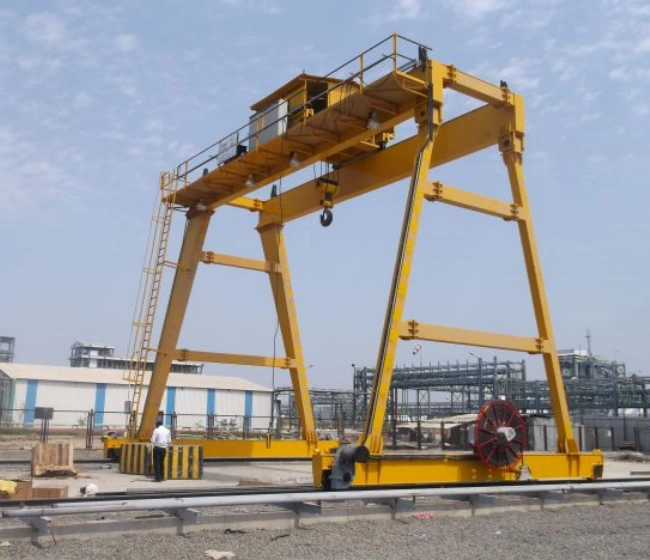
CRANE OPERATOR SAFETY OPERATING PROCEDURES
1.The crane operator is a special type of worker. They must undergo professional safety and technical training, pass the examination and obtain the "Special Equipment Safety Operating Certificate" before they can operate the crane safely and accurately.
2. Carefully inspect the machinery, electrical equipment, control system, safety protection devices, safety devices, signal devices, fire extinguishers to ensure they are complete, in good condition and functioning properly. After confirming everything is normal, activate the main protection switch and conduct a trial run of each mechanism. Confirm that each mechanism, control device, linkage and positioning device is flexible and reliable. Then record this in the on-site record book. If there are any issues, report them immediately. Do not operate without authorization.
3. One should walk and get on/off the vehicle along the designated safety passage and on the dedicated platform. The driver must maintain full concentration during operation and is not allowed to engage in activities that distract attention (such as using a mobile phone, etc.). When the crane is starting, lifting, lowering, or when it is necessary to wait or give a warning, it should first sound the alarm.
4. The driver must follow the signals given by the lifting supervisor and can only operate after receiving the signal from the supervisor. When the supervisor's signal changes, the driver should use a warning sound and issue a "repeat" signal to clarify the situation before proceeding with the operation.
5. When lifting a heavy object, a trial lift operation must be conducted first. Raise the heavy object to within 30 centimeters from the supporting object, then pause to observe. Ensure that the lifting equipment, the heavy object, and the crane are all stable without any abnormalities and there is no shaking sound before proceeding with the lifting operation.
6. If there are multiple people (two or more) involved in an electric vehicle accident and there is a dispute over the vehicle, the driver has the right to refuse to operate.
7. When using slings for lifting, flipping and transporting, one must carefully check for any items with sharp edges or openings to prevent accidental contact and damage to the slings. In cases where there are main and auxiliary cranes, during operation, the unused lifting hooks should be raised to the top. It is strictly prohibited to use two cranes simultaneously to lift two objects, and it is forbidden to operate three handles or press the buttons simultaneously.
8. In areas with hazardous loads, no lifting or operation is allowed. When the crane is approaching the lifting stopper, and the trolley and crane are close to the final movement and encounter another crane, the speed should be reduced, and point operation should be carried out. It is not allowed to use reverse gear as emergency braking. Besides using position instead of stopping, and emergency stop switch instead of ordinary switch, it is strictly prohibited to move in the air for a long time.
9. In case of sudden power outage during operation, the switch handle must be turned back to the zero position. If the lifted object has not been lowered or the equipment has not been in place, and it is not in the machine room, and power cannot be restored immediately, corresponding measures should be taken (slowly release the lifting mechanism manually) to lower the lifted object.
10. If the braking system fails during mid-journey inspection, the crane will automatically descend. The driver must not panic. Instead, they should remain calm and clear-headed. They should first sound the alarm to alert the workers below. At the same time, they should adopt the reverse point movement measure to move the load to an open area above, and then slowly lower the load to the ground.
11. When an outdoor crane is exposed to storms, lightning, heavy fog or strong winds (with wind force reaching level 12 or above), it should follow the relevant emergency procedures for operation. The crane should be stopped, the power supply cut off, and the crane fixed using the brake. At the same time, the hoist cylinder should be shut down and safety devices should be properly installed.
12. After the work is completed, the crane should be parked at the designated position, the lifting mechanism should be raised, the trolley should be moved to the end, and all control handles should be placed at the "zero position", and the power supply should be cut off. For outdoor cranes, they should be fixed using large trackers, and iron shoes should be installed for adequate fixation and protection.