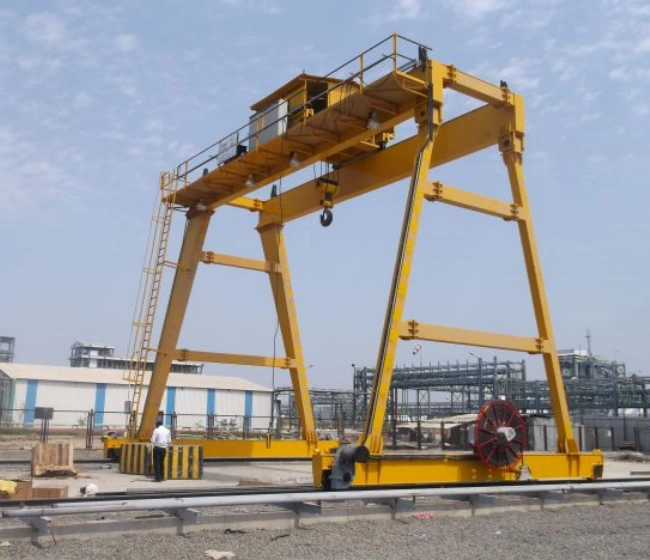
What Is a Casting Crane? YZ vs YZS Double Girder & Four Girder Ladle Crane for Steel Mills
Understanding the Casting Crane: The Backbone of Steelmaking Operations
A casting crane serves as the primary lifting and material handling equipment in steel mill melting workshops. Its core functions include transferring, pouring, and mixing liquid metal throughout the steelmaking process. These heavy-duty machines operate under extremely demanding conditions, requiring exceptional reliability and safety standards.
YZ Double Girder Casting Crane: The Standard Solution for Medium Loads
For lifting capacities up to 125 tons, the YZ double girder casting crane is the industry standard. This configuration features:
Double Girder, Single Trolley Design – The structure consists of two main girders supporting one trolley
Main Components – Bridge, trolley, crossbeam, trolley drive mechanisms, and electrical systems
Fixed-Spacing Hook Beam – The main hoisting device utilizes a fixed-spacing hook beam specifically designed for lifting molten steel ladles
Auxiliary Hook Function – Works alongside the main hook for tilting operations, slag handling, and other supplementary lifting tasks
YZS Four Girder Casting Crane: Heavy-Duty Engineering
When lifting capacities exceed 125 tons, the YZS four girder structure becomes necessary. This advanced configuration includes:
Main and Auxiliary Double Trolley System – Four girders with four rail tracks
Structural Composition – Bridge frame, main trolley, auxiliary trolley, hook beam, trolley drive mechanisms, and electrical components
Dual Rail Operation – The main trolley operates on outer main girder rails, while the auxiliary trolley runs on inner auxiliary beam rails
Specialized Hook Beam – The main trolley features a fixed-spacing hook beam for ladle handling
Positioning Advantage – The auxiliary trolley is positioned beneath the main trolley, equipped with a hook that coordinates with the main hook for steel pouring, slag handling, and auxiliary lifting operations
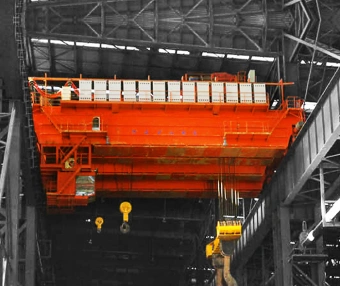
Engineered for Extreme Environments: Heat Protection and Safety
Casting cranes work in harsh environments characterized by high temperatures and heavy dust. Several design features address these challenges:
Cooling System Integration
The trolley drive mechanisms and main electrical equipment are housed within the main girders, with cooling fans installed in the main beam electrical rooms to prevent overheating.
Heat Shielding
Thermal insulation panels are installed along the bottom of the main girders to minimize heat radiation from molten metal onto structural components.
Four-Corner Drive
The travel drive mechanism adopts a four-corner drive configuration, ensuring stable and balanced movement even under full load conditions.
Precision Weighing and Monitoring Systems
Every casting crane is equipped with a specialized electronic scale system. Clear digital displays are provided in both the operator cabin and on the control panel, allowing real-time weight monitoring during ladle handling operations.
Three Essential Characteristics of Casting Cranes
1. High Reliability – The Top Priority
Casting cranes are specifically designed for lifting molten steel and iron—operations where failure is not an option. An accident involving spilled molten metal would have catastrophic consequences. For this reason, multiple safety devices are installed on the main hoist structure to ensure absolute operational safety. These include overload protection, dual emergency brakes, limit switches, and anti-collision systems.
2. Stable and Smooth Operation
Steel production demands continuous crane operation with high manufacturing efficiency and extremely short cycle times. This places strict requirements on crane performance. A lack of rigidity or inferior quality can lead to premature component failure or electrical system issues. If a crane breakdown causes a converter shutdown, the financial losses are substantial. Therefore, equipment quality must ensure safe, stable, day-to-day operation without interruption.
3. Easy Maintenance Access
Maintenance convenience is critical for casting cranes. Any equipment issue can disrupt the entire steelmaking workshop's production. To minimize negative impacts on production schedules, the crane design must enable quick and convenient maintenance access. Features such as modular components, accessible inspection points, and clearly labeled electrical systems significantly reduce downtime during repairs.
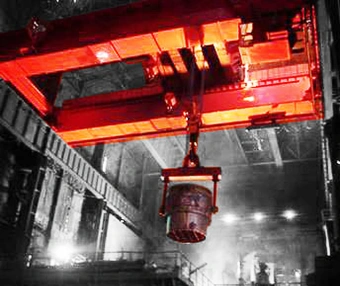
Technical Specifications Overview
| Capacity Range | 5t up to 400t |
| Span Range | 10m to 40m |
| Lifting Height | 15m to 30m |
| Duty Class | A7 to A8 (Heavy/Extra Heavy Duty) |
Why Proper Operation Matters
Casting cranes are indispensable assets in the steel manufacturing process, used throughout melting shops for lifting molten steel or iron. Given their critical role and the hazardous nature of their operating environment, proper usage protocols are essential. Only when operated correctly—following established safety procedures and maintenance schedules—can the complete machine ensure safe, reliable service throughout its designed lifespan.
Frequently Asked Questions
What is the difference between YZ and YZS casting cranes?
The main difference lies in their structural configuration. YZ cranes use a double girder with single trolley design for capacities up to 125 tons. YZS cranes feature a four girder, four rail design with main and auxiliary trolleys, designed for capacities exceeding 125 tons.
What are the key safety features of a casting crane?
Casting cranes include overload protection devices, dual emergency brake systems, travel limit switches, anti-collision systems, and heat shielding on the main girders.
Why is heat protection important for casting cranes?
Because casting cranes operate near molten metal at extremely high temperatures. Thermal insulation panels, cooling fans for electrical rooms, and heat-resistant coatings protect both the equipment and operators.
What is the typical lifespan of a casting crane?
With proper maintenance and operation, casting cranes can provide reliable service for over 20-30 years, as evidenced by cranes originally commissioned in the 1990s still undergoing refurbishment rather than replacement.
Need More Information?
If you have any questions about casting crane selection, specifications, or applications, feel free to contact us. Our technical team can help you determine whether a YZ double girder or YZS four girder solution best fits your steel mill requirements.