Gantry Crane vs Overhead Crane: Which Is Better for Your Facility?
If you’re searching for “gantry crane vs overhead crane”, you’re likely facing a common dilemma: which type of crane will work best for your facility?
Both are excellent material handling solutions, but they serve different purposes. Choosing the wrong one can lead to wasted space, higher costs, or even safety risks.
In this guide, we’ll break down:
The key differences between gantry cranes and overhead cranes
Pros and cons of each
A decision framework to help you choose
-
Real-world application examples
By the end, you’ll know exactly which crane is right for you.
Quick Answer: Which One Is Better?
There is no universal “better” crane. The right choice depends entirely on your facility, budget, and application.
Choose a gantry crane if you need mobility, outdoor operation, or don’t have an existing building structure.
Choose an overhead crane if you have a permanent indoor facility with strong support columns and need maximum space efficiency.
What Is an Overhead Crane?
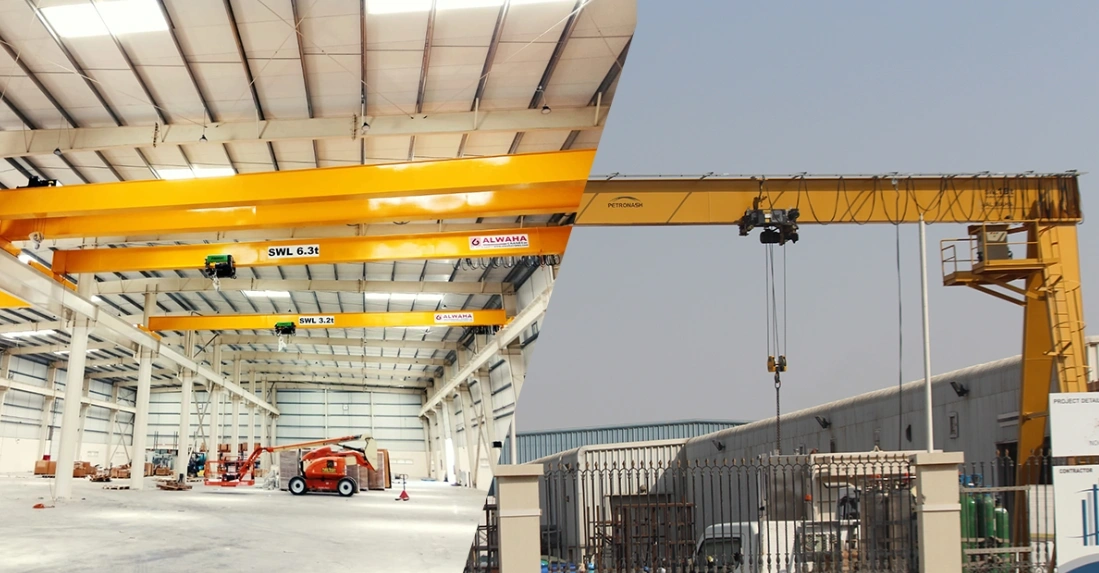
An overhead crane (also called a bridge crane or EOT crane) runs on runway beams attached to the building’s support columns. The crane bridge spans the width of the facility and travels along the runway.
Key Characteristics:
Permanently installed – requires building structure
Uses overhead space – leaves floor area clear
Higher lifting capacity – typically 1 ton to 500+ tons
Faster travel speeds – ideal for production lines
Best Applications:
Manufacturing plants
Warehouses with high bay clearance
Steel service centers
Assembly lines
What Is a Gantry Crane?
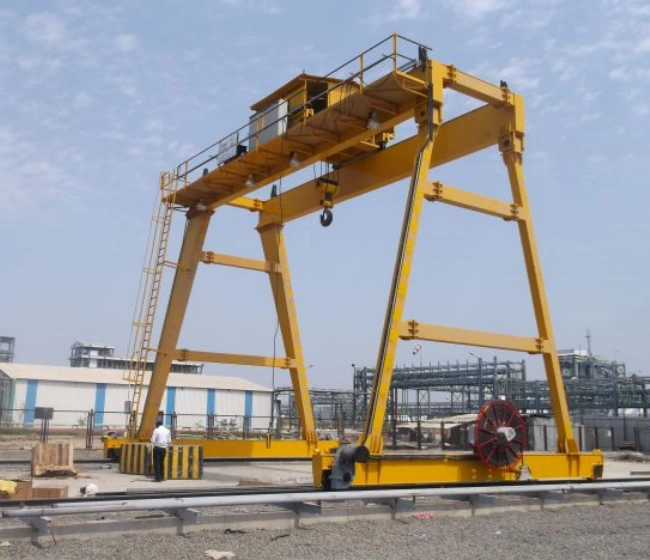
A gantry crane is similar to an overhead crane, but its legs run on ground-level rails or wheels. The entire crane is self-supporting and does not require building attachment.
Key Characteristics:
Can be mobile or fixed – some models are portable
No building support needed – stands on its own legs
Lower to medium capacity – typically 0.5 ton to 100+ tons
Outdoor capable – weather-resistant designs available
Best Applications:
Outdoor storage yards
Shipping ports and container yards
Construction sites
Shipyards and boat yards
Head-to-Head Comparison: Gantry Crane vs Overhead Crane
| Feature | Overhead Crane (Bridge Crane) | Gantry Crane |
|---|---|---|
| Building Required | Yes – needs runway beams on columns | No – freestanding |
| Floor Space Usage | Excellent – leaves floor clear | Moderate – legs take floor space |
| Mobility | Fixed – cannot be moved | Can be mobile (RTG) or fixed |
| Outdoor Use | Limited (enclosed building only) | Yes – designed for outdoor |
| Typical Capacity | 1 – 500+ tons | 0.5 – 100+ tons |
| Installation Cost | Higher (building mods often needed) | Lower to moderate |
| Installation Time | Weeks to months | Days to weeks |
| Span Range | 10 – 40 meters (can be wider) | 3 – 30 meters (portable smaller) |
| Headroom Required | Moderate (can use low headroom design) | Higher (legs raise the beam) |
| Relocation Possibility | Difficult and expensive | Possible with some models |
| Best For | Permanent indoor production | Versatile indoor/outdoor, temporary or changing layouts |
Pros and Cons
Overhead Crane (Bridge Crane)
Pros:
Maximizes floor space – nothing on the ground
Very high lifting capacities available
Fast travel speeds for production efficiency
Can use full building width as span
Cons:
Requires building reinforcement
Expensive to install and relocate
Not suitable for outdoor use
Longer lead time for installation
Gantry Crane
Pros:
No building modification required
Lower initial investment
Can be used outdoors
Portable models available for multiple workstations
Faster installation
Cons:
Legs take up usable floor space
Generally lower capacity than large overhead cranes
May require more headroom
Mobile models need level ground
Decision Framework: 5 Questions to Ask Yourself
Question 1: Do you have an existing building with strong support columns?
Yes → Consider an overhead crane
No or unsure → Gantry crane is likely better
Question 2: Will the crane be used indoors or outdoors?
Indoors only → Both work, but overhead crane saves floor space
Outdoors → Gantry crane is required
Question 3: What lifting capacity do you need?
Under 20 tons → Both are viable
Over 20 tons → Overhead crane is more common (but large gantry cranes exist)
Question 4: Do you need to move the crane to different locations?
Yes → Mobile gantry crane
No → Either fixed gantry or overhead crane
Question 5: What is your budget and timeline?
Lower budget, faster installation → Gantry crane
Higher budget, permanent solution → Overhead crane
Quick Selection Guide (Scenario-Based)
| Your Scenario | Recommended Crane |
|---|---|
| Small workshop, occasional heavy lifting | Portable gantry crane |
| Large factory, continuous production | Overhead bridge crane |
| Outdoor scrap yard, changing piles | Rubber tired gantry crane (RTG) |
| New building construction site | Gantry crane (temporary) |
| Shipping container handling | Rail mounted gantry crane (RMG) |
| Automotive assembly line | Overhead crane with anti-sway |
| Boat yard for vessel maintenance | Gantry crane (outdoor) |
| Warehouse with high racks | Overhead crane (to save floor space) |
Frequently Asked Questions
Can I use an overhead crane outdoors?
No. Standard overhead cranes require a covered building with runway beams. For outdoor use, choose a gantry crane.
Which is cheaper: gantry crane or overhead crane?
Gantry cranes generally have lower upfront costs because they don’t require building modifications. However, for very high capacities (100+ tons), overhead cranes can be more cost-effective.
Can I turn a gantry crane into an overhead crane?
No. They are different structures. But some gantry cranes can be converted to semi-gantry (one side on rails, one side on legs).
How long does installation take?
Gantry crane: 1–7 days for most models
Overhead crane: 2–8 weeks (including building preparation)
Do I need special permits for either crane?
Yes, for both. Most regions require permits and inspections for fixed cranes. Mobile gantry cranes under a certain capacity may have fewer requirements. Always check local regulations.
Still Not Sure? Get a Free Recommendation
Every facility is unique. The right crane depends on your:
Building structure and headroom
Lifting capacity needs
Budget and timeline
Indoor vs outdoor operation
Future expansion plans
Our engineering team can help you decide with a free, no-obligation consultation.
RMG vs RTG Crane: Key Differences & Which One Fits Your Yard Best?