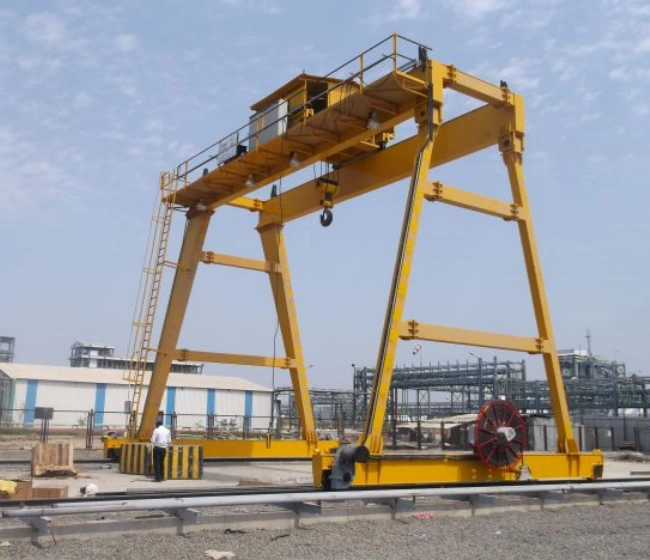
Gantry Crane vs Overhead Crane: What’s the Real Difference?
If you work in factories, warehouses, ports, or outdoor storage yards, you’ve likely seen two very common types of cranes: overhead cranes and gantry cranes.
At first glance, they look similar — both have a bridge structure moving along a track. But their supporting structure, application environment, and cost are significantly different.
In this article, you’ll learn:
What is an overhead crane?
What is a gantry crane?
Key differences between them
How to choose the right one for your project
1. The Fastest Way to Tell the Difference: Look for the “Legs”
A simple rule of thumb:
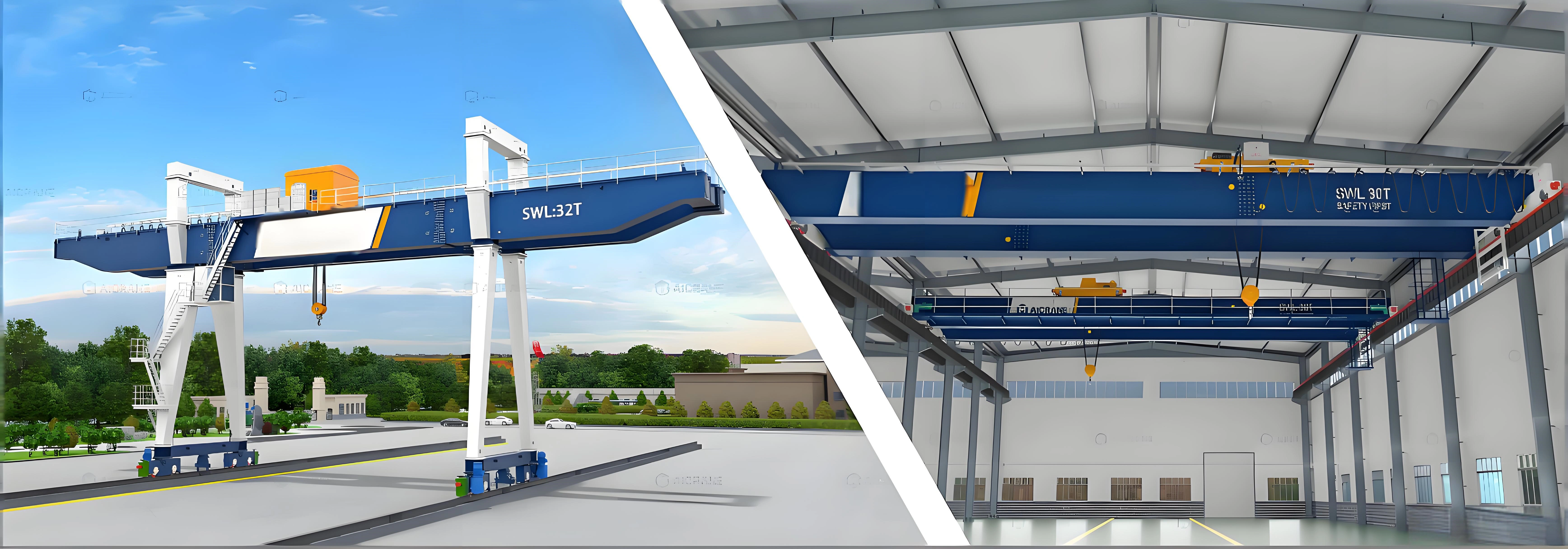
An overhead crane “rides” on the building walls. A gantry crane “stands” on the ground.
Overhead Crane (Bridge Crane)
Runs on rails fixed to building columns or support beams
No legs — it’s suspended from the ceiling structure
Also called: bridge crane, electric overhead traveling (EOT) crane
Gantry Crane
Has two or more legs standing on the ground
Legs are fitted with wheels that run on ground-level rails
Also called: portal crane, rail-mounted gantry crane
2. Comparison Table: Overhead Crane vs Gantry Crane
| Feature | Overhead Crane | Gantry Crane |
|---|---|---|
| Structure | No ground legs, runs on building rails | Has ground legs, portal shape |
| Running Track | Mounted on building beams | Laid on ground or concrete foundation |
| Typical Location | Indoor workshops, factories | Outdoor yards, ports, rail terminals, steel yards |
| Lifting Capacity | Usually 1–500 tons | Usually 5–2000 tons (custom larger) |
| Span | Limited by building width | Wider spans available |
| Civil Work | Requires factory building and support beams | Requires ground rail and foundation |
| Weather Impact | None (indoor operation) | Affected by wind, rain, snow (needs wind protection) |
| Cost | Lower (leverages building structure) | Higher (independent structure + foundation) |
| Typical Use | Machining, assembly, warehouses | Container handling, precast concrete, scrap yards |
3. How to Choose: Which Crane Is Right for You?
✅ Choose an Overhead Crane If:
You already have a factory building with load-bearing beams
Operation is mostly indoors
You want to minimize civil construction costs
Protection from wind, rain, dust is required
📌 Typical industries: auto manufacturing, die-casting, warehouses, steel rolling mills
✅ Choose a Gantry Crane If:
You have no building, or the building can’t support a crane
Operation is outdoors
You need to move the entire crane frequently
Lifting extra-long or oversized loads (e.g., wind blades, bridge segments)
📌 Typical industries: ports, railway cargo yards, precast concrete plants, steel recycling yards
4. Common Misunderstandings
❌ Myth 1: Gantry cranes are always stronger than overhead cranes
✅ Fact: Both types come in very high capacities. Overhead cranes can also lift hundreds of tons.
❌ Myth 2: Overhead cranes cannot be used outdoors
✅ Fact: Special weatherproof overhead cranes exist, but they require wind bracing, rain covers, and anti-corrosion treatment.
❌ Myth 3: All gantry cranes need rails
✅ Fact: There are also rubber-tired gantry cranes that move freely without fixed tracks.
5. Summary in One Sentence
An overhead crane relies on the building — it’s the indoor workhorse.
A gantry crane is a self-standing system — it’s the outdoor all-rounder.
To choose the right crane, ask two simple questions:
Indoor or outdoor operation?
Do you already have a factory building with support beams?
Your answers will point you directly to the right crane type.
6. Get Expert Support
We supply and customize:
CD/MD wire rope electric hoists (0.5–16 tons)
Single-girder / double-girder overhead cranes
Single-girder / double-girder gantry cranes
Non-standard lifting solutions
Contact our engineers for a free recommendation based on your site and load requirements.